Case study
Seismic revival: reprocessing legacy data for carbon capture and storage
10 Dec 2025
Navigating congested infrastructure and aging seismic data, Perenco partnered with Shearwater to turn a challenge into an opportunity—rejuvenating legacy datasets to accelerate characterisation of carbon capture and storage (CCS) sites using advanced imaging techniques. For energy leaders managing CCS investment decisions, this project demonstrates how technical innovation and operational agility can unlock value faster, with lower risk and greater clarity.

Perenco is an independent hydrocarbon producer involved in the entire life cycle of projects; from exploration to decommissioning and carbon storage.
The Anglo-French company operates in 14 countries with head offices in London and Paris. Perenco is at the forefront of carbon capture and storage (CCS) and holds three CCS licences within the UK awarded in 2023 in the Southern North Sea with its partners. These licences comprise the flagship projects Poseidon and Orion formed by the Amethyst and West Sole depleted gas fields.
THE
CHALLENGE
The Amethyst and West Sole fields form Perenco’s Orion Project, designed to complement Perenco’s Poseidon Project by providing secure and scalable storage capacity by expanding on the estimated 1 gigaton Poseidon capacity. Located in the Southern North Sea, these congested legacy fields presented a logistical challenge for new seismic data acquisition potentially requiring a combination of both towedstreamer and Ocean Bottom Node. Considered in combination with the relatively less complex overburden in this part of the Southern North Sea, re-processing legacy data unlocked a more efficient and effective route to deliver high-quality, uniform, seismic coverage for Perenco.
To sufficiently characterise the Amethyst and West Sole sites for carbon storage purposes, we needed the best quality seismic data. In the appraisal phase before final investment decision (FID) new seismic acquisition was not financially viable, so leaning on previously acquired datasets and reprocessing them to better image the intended storage unit, caprock and overburden was integral to our work programme, says Chris Furby, Geophysicist at Perenco.
THE
SOLUTION
The Amethyst and West Sole projects used legacy data as the starting point for the reprocessing. Legacy data for CCS comes with numerous challenges including data quality (frequency content, noise), acquisition parameters (optimised for different targets) and the data archives themselves with ancillary data, such as navigation, often of poor quality, incomplete or simply missing.
In this instance, the challenge was input data acquired in 1985 and 1993 to 1994; including the first commercial Ocean Bottom Cable (OBC) data shot in the UK. Challenges posed by the input data included large inline offsets, large nominal bin sizes and poor low frequency content with acquisition filters of up to 6 Hz. However, this area of the Southern North Sea is very congested making new acquisition both complex and costly with combined streamer and node multiple vessel acquisition needed to obtain single contiguous datasets. Leveraging existing legacy datasets through enhanced reprocessing can therefore provide a more cost-effective solution that accelerates timelines to unlock project progression.
KEY POINTS
OF THE
SOLUTION
- West Sole – covered by towed-streamer (1985) and Ocean Bottom Cable (OBC) (1993-1994) data
- Amethyst – covered by towed-streamer (1993) data

There was significant potential for uplift in imaging quality, especially at the target depth where positioning and displacement behaviours of faults is important. In the near surface, the legacy image was very poor with heavy multiple contamination. The objective was to improve imaging of the primary storage unit at the Lower Leman Sandstone, Zechstein caprock and overburden, with special attention paid to fault imaging and depth positioning. Whilst close together, each field required a separate bespoke workflow to account for structural differences and the OBC element specific to West Sole with the merging of the two input datasets specific to that field.
Seismic data was re-processed to support site characterisation of the mature gas reservoirs for carbon storage purposes in both survey areas. This included advanced imaging techniques such as de-ghosting, de-multiple (using multi-model, multi-domain subtraction), and full velocity model building with depth imaging, including Full Waveform Inversion (FWI). The West Sole survey also integrated data from both towed-streamer and Ocean Bottom Cable (OBC) acquisitions to ensure comprehensive coverage.
Whilst close together, each field required a separate bespoke workflow to account for structural differences.
We took a collaborative approach to ensure Perenco’s objectives were met, bringing in experience gained from our work on several shallow water CCS projects to tackle the challenges of de-noise and de-multiple. But the age of the data presented an additional challenge with limited near inline offsets and low-frequency content requiring a focus on extracting maximum resolution.
Within the Amethyst survey area is an erosional Quaternary channel system, somewhat similar to that observed in the Morecambe Net Zero project. Through the application of FWI, a detailed velocity model was obtained capturing the slow velocity infill and highvelocity Chalk; a critical step in healing image and depth positioning at target level. Two depth slices are shown through the new surface comparing the PSDM stack, FWI input model, FWI output model and perturbation. Near surface velocity anomalies are clearly captured through FWI and are constrained by the underlying geology.
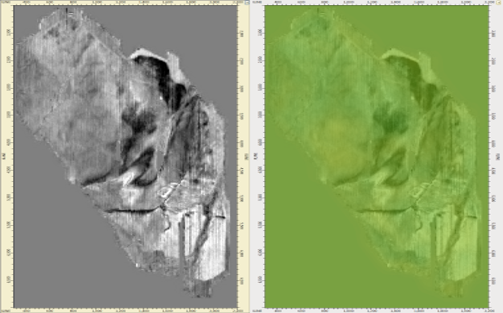
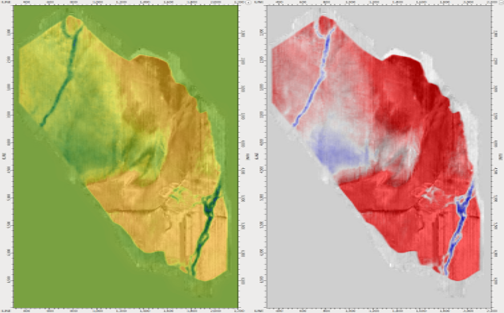
Image: Depth Slice at 140m
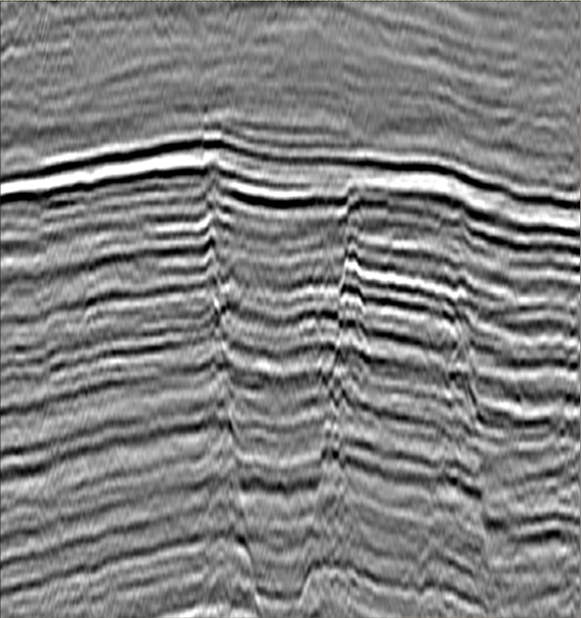
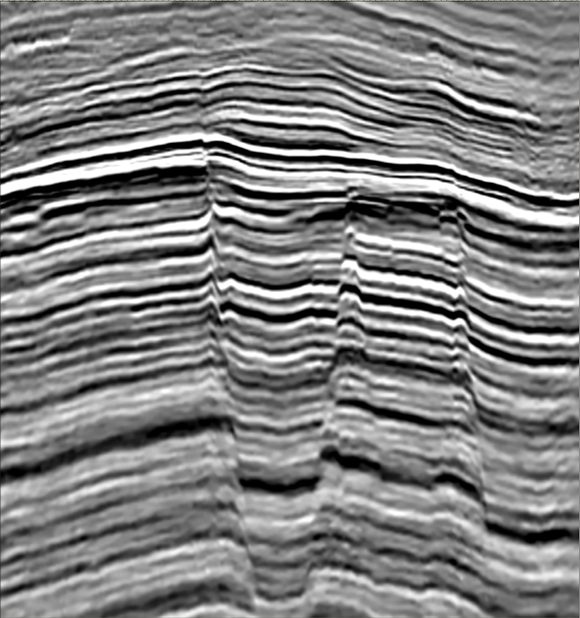
Image: Final Amethyst stack comparisons of legacy data against re-processed PSDM data.
West Sole lacked these channel systems but had the challenge of requiring a merge between Ocean Bottom Cable (OBC) and towed-streamer seismic data. Combining multiple datasets with inherently different frequency content and coverage is never easy however the result was a single contiguous quality dataset fit for the purpose of site characterisation for CCS.
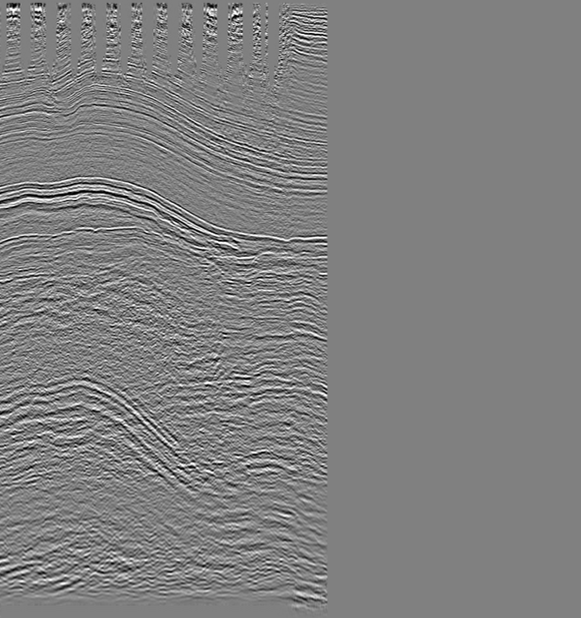
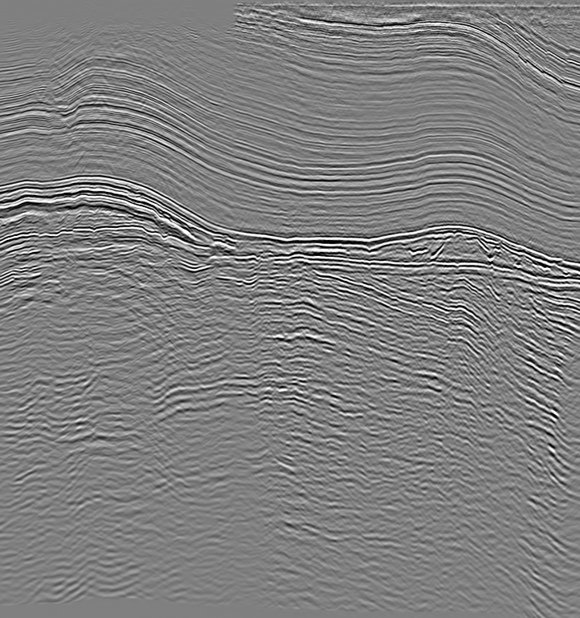
Image: Final stack comparisons show a seamless high-quality merge of towed streamer and OBC data.
THE
RESULT
This project demonstrates the strategic value of rejuvenating legacy seismic datasets for CCS applications. By re-processing the Amethyst and West Sole data—using full processing, velocity model building, and depth imaging—Perenco gained a detailed subsurface characterisation for its Orion project.
"With improvements made to seismic dataset quality delivered by Shearwater, we are able to advance our structural models and better characterise our stores with the level of detail required for CCS licences."
Marta Puig-Alenya,
CCS Subsurface Manager at Perenco
The enhanced imaging, from the near surface down to the reservoir level, provided sharper resolution and deeper insight into geological challenges. It strengthened confidence in interpreting the compartmentalised nature of the gas reservoirs and the complexity of overburden faulting. Crucially, the integration of Ocean Bottom Cable (OBC) and towed-streamer data on West Sole produced a single, seamless volume of high-quality seismic data—delivering a robust foundation to advance the Orion CCS project with clarity and confidence.
3
Datasets from 1985, 1993 and 1994 brought back to life.
900
km2 merge of Towed Streamer with Ocean Bottom Cable data.
2
Quality dataset fit for the purpose of CCS evaluation.
Acknowledgement
Thanks go to Perenco for permission to share this work.
Thanks also go to the Shearwater project teams and support groups for delivering the processing.
WATCH THIS
SPACE
As Shearwater’s portfolio on CCS projects expands, so does our experience base. All our learnings across acquisition and processing are combined and our technical experts continue to enhance our integrated solutions through continuous improvement and partner collaboration – solving CCS challenges and contributing to the energy transition.
Recent developments include:
- Shearwater can now provide zero-offset trials on both zero offset solutions through our proprietary Qmarine and Isometrix technology. Investment in sea trails on 2 separate vessels to ensure the solution could be provided efficiently and safely allowed us to update our mobilisation procedures and provide confidence to our future clients looking for a step-up in resolution.
- An upgrade to our Isometrix technology through 1ms sampling offers a Single Sensor, Multi Component and now Zero-offset High-Resolution solution well suited to meet CCS challenges. Tests showcasing the possibility of 1ms sampled multi-component solutions.
- Roll-out of Elementi FWI, our new Spectral Elements Method (SEM) FWI, pushing the limits of sub-surface imaging.
News
Press Release
08/09/2026
Shearwater awarded North Sea OBN survey featuring first deployment of electric ROV technology

GET IN TOUCH
Dave Forecast, our storage solutions expert is here to help.