Hybrid P-only and PZ de-ghosting of Isometrix at ultra-high frequencies
The Isometrix streamer platform has the ability to acquire multiple seismic data types simultaneously, allowing the most appropriate dataset to be selected and optimized for each specific application and subsurface objective.
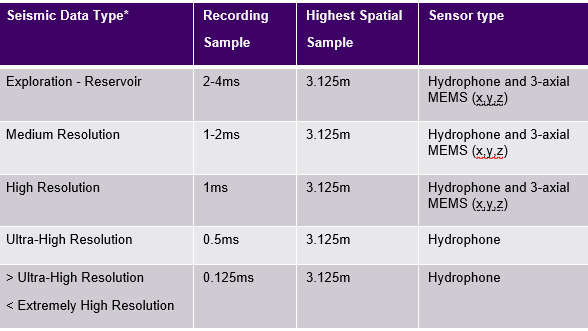
* After Hill et al., 2024, A proposed standard for seismic frequency nomenclature for geophysical site investigation surveys in the offshore energy sector. First Break
The capability of the Isometrix streamer to record simultaneous 1ms PZ and 0.125ms P-only data, opens up new possibilities for hybrid de-ghosting at high frequencies. The challenge with de-ghosting of hydrophone-only data essentially boils down to the limited accuracy of two key measurements – the precise depth of each receiver, and the exact sea state at each receiver. While these must typically be estimated from the seismic data, the use of multicomponent data at the lower frequencies provides some additional options to estimate these parameters.
As the Isometrix streamer records 3-component acceleration at every 62.5cm, by isolating the horizontal acceleration along the streamer it is possible to output a precise estimate of the depth deviation of the streamer at each sensor. This is because the change in depth with respect to distance along the streamer is proportional to the DC component of the acceleration with respect to the acceleration due to gravity:
dzdx=Ax(0)g
This relative depth deviation along the streamer can then simply be added to the objective depth measurements at the depth controllers, providing an accurate and precise depth estimate at each receiver:
Figure 1: Receiver depth for a shot; linearly interpolated from depth sensors (blue) compared to depths updated with cable profile estimates from the AX component at each sensor (red). The cable arches and sags are not measured by the depth sensors located between sections.
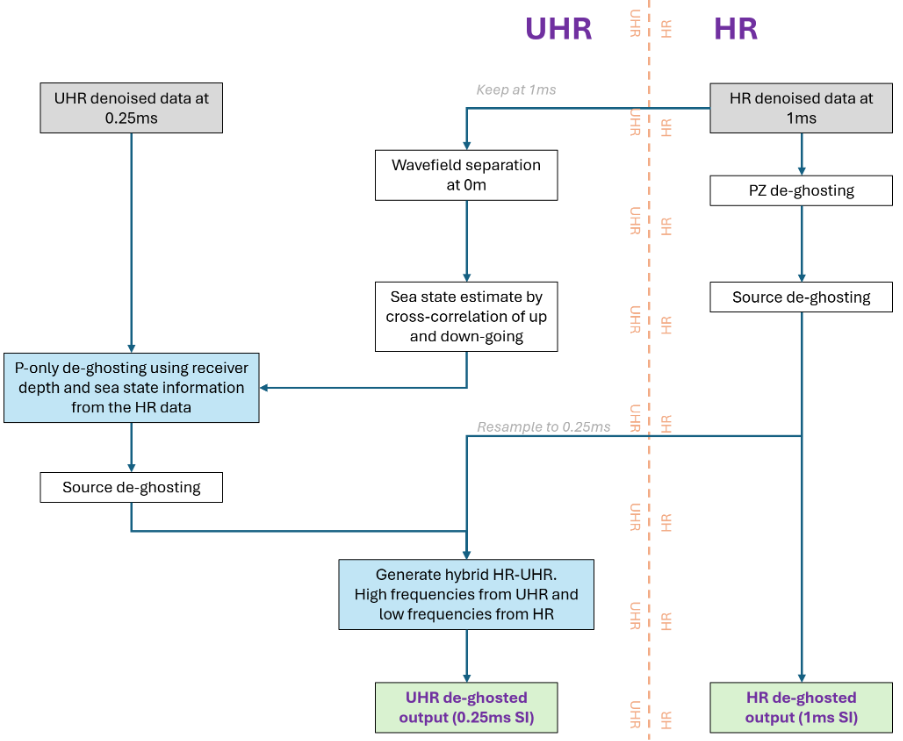
The multicomponent data also provides a method for estimating the sea state at each receiver, through cross-correlation of the separated up-going and down-going wavefields. After accounting for the obliquity, this provides an estimate of the sea height for each receiver, as a snapshot of time at the water bottom or another chosen event, which can be used to guide the ghost model during P-only de-ghosting of the UHR hydrophone-only data.
Making use of the streamer depth profile – estimated using the DC acceleration along the streamer – and estimating a sea surface profile by cross-correlating the separated up-going and down-going wavefields from the 1ms data, it is possible to achieve a superior de-ghosting results in the P-only data at much finer sample rates. Test results show that the use of both depth and sea surface estimates from 1ms PZ data significantly improves de-ghosting results on 0.25ms hydrophone data, with better suppression of the receiver ghost and greatly reduced ringing noise.
Figure 2: UHR de-ghosting with: (a) no prior information, (b) estimated cable profile from HR acceleration data, (c) estimated cable profile and sea surface profile. The use of the 1ms data to guide the de-ghosting significantly reduces both ringing and residual ghost events.
As the 1ms and UHR data are recorded at the same sensor positions, further reduction of ringing noise and residual ghost events at lower frequencies is possible through creation of a “hybrid” dataset, taking the low-frequency portion (0-400Hz) from the 1ms PZ data and combining this with the high frequencies from the 0.25ms P-only data. This way the resultant data gains maximum benefit from the extended bandwidth of the P-only data, while retaining the benefits of multicomponent de-ghosting at lower frequencies.
Figure 3: flowchart outlining the HR and UHR de-ghosting process