Insight article
Setting the course: five standout papers from 2024
27 Jan 2026
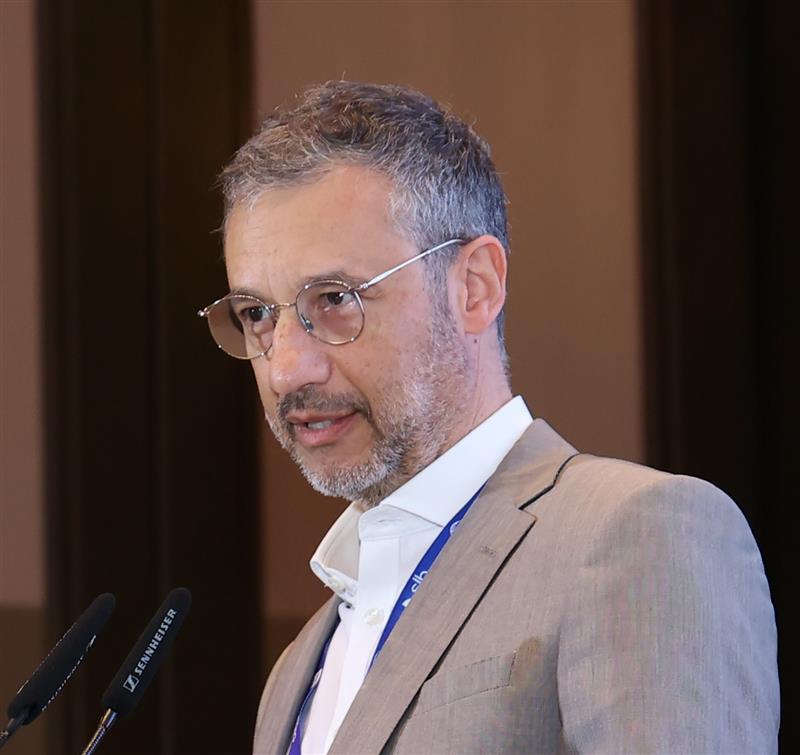
 Sergio Grion, Chief Geophysicist – processing and imaging technology, Shearwater
As the geophysical industry continues to navigate a period of transformation and uncertainty, the importance of focused, forward-looking research has never been greater.
In this article we look back at our 2024 research work and showcase the top five technical papers presented by Shearwater. It was a year distinguished by remarkable scientific resilience and innovation. Together with our strategic choice of Spectral Elements Full Waveform Inversion as our imaging technology platform (read press release), these papers reflect not only the company’s commitment to advancing geophysical understanding, but also its strategic response to evolving market dynamics and operational challenges.
By showcasing these standout contributions, we aim to provide insight into the research directions that are shaping the future of subsurface imaging, data processing, and exploration efficiency.
Writing this now, at the beginning of 2026, offers a moment of reflection: to assess the impact of these works, understand their relevance in today’s context, and reaffirm the value of R&D as a compass for navigating complexity.
“These papers are more than technical achievements — they are signals of intent, direction, and purpose.”
– Sergio Grion, Chief Geophysicist – Processing Technology
The first broadband marine 3D vibrator survey
Authors: Elboth, Evensen, Laws, JafarGandomi
Conference: EAGE
Why it matters :
The paper presents the first successful acquisition of a broadband 3D marine seismic survey using towed vibroseis, demonstrating a viable alternative to traditional air sources.
Differently from air sources, a marine vibroseis dilutes acoustic energy over time and allows for precise control of amplitude and phase. By covering the full seismic frequency range (3–150 Hz) and employing innovative techniques like phase encoding and depth-optimized deployment, the study shows improved data quality, reduced environmental impact, and promising results for future applications such as Full Waveform Inversion (FWI).
Effective processing of the first broadband 3D marine vibrator data acquired in the North Sea
Authors: JafarGandomi, Holland, Howard, Wang, Elboth
Conference: EAGE
Why it matters :
This paper demonstrates the successful processing and imaging of the first broadband 3D marine vibroseis data acquired in the North Sea, showing results comparable to conventional air source surveys despite significantly lower emitted energy.
By converting continuous sweeps into equivalent impulsive source data and applying advanced deconvolution techniques, the study validates this technology as a viable, lower-impact alternative for large-scale seismic acquisition.
Seismic uncertainty quantification beyond the normal
Authors: Rizzuti, Vasconcelos, Casasanta
Conference: IMAGE
Why it matters :
This paper introduces a new method to better estimate uncertainty in seismic data analysis, especially when traditional methods fall short.
Using advanced machine learning techniques, the authors smooth out complex mathematical challenges to improve predictions of underground features like acoustic impedance. Their approach allows for more realistic modelling by moving beyond standard assumptions, helping geoscientists make more confident decisions in exploration and subsurface imaging.
This innovation opens new possibilities for more realistic and flexible uncertainty modelling in seismic inversion workflows.
Reaching the Pantheon: a multidisciplinary approach to data reprocessing and depth imaging in the Vulcan sub-basin.
Authors: Artemov, Dunne, Ganivet, Chambath
Conference: ASEG
Why it matters :
This study showcases a successful reprocessing of the Pantheon 3D seismic survey in the Vulcan sub-basin, Timor Sea, using a multidisciplinary approach that integrates advanced imaging techniques, velocity model building, and rock physics.
By applying modern methods such as Full Waveform Inversion (FWI), Q tomography, and gravity modelling, the team significantly improved data quality and resolved long-standing imaging challenges, particularly around the Vesta structure.
The findings challenge previous interpretations of salt diapirism and offer new insights into subsurface geology, enhancing hydrocarbon exploration potential in the region.
Optimization strategy for SRME on highly parallel hardware
Authors: Nauta, Casasanta
Conference: Energy HPC Conference
Why it matters :
Efficient use of high performance computing (HPC) resources enables more sophisticated data processing and reduces turnaround time.
This paper presents an optimized strategy for running Surface-Related Multiple Elimination (SRME) on GPUs and high-core count CPUs, focusing on minimizing data movement from disk to fast memory. By exploiting multiple levels of parallelism and redundancy in both computation and data access, the authors achieve significant performance gains while maintaining reproducibility.
The approach enables scalable, efficient SRME processing on modern hardware, making it well-suited for large seismic datasets in high-performance computing environments.
Reflections on 2024 – and what’s next
Looking back, 2024 was a year where Shearwater’s research efforts aligned with both technological ambition and operational relevance. Each of the five papers selected here represents a deliberate step toward solving real-world geophysical challenges, whether through hardware-aware processing strategies, environmentally conscious acquisition methods, or more nuanced uncertainty modelling.
These contributions didn’t just push boundaries; they clarified them. As we move into 2026 and get ready to review 2025, the question is not only what comes next, but how we continue to build on this momentum. Expect deeper integration of machine learning, further developments of marine vibrator technology, more scalable HPC workflows, and industrial demonstrations of spectral-element full waveform inversion.
The future will demand even greater precision, adaptability, and collaboration across disciplines. If 2024 was about proving what’s possible, the years ahead must be about making it practical—at scale, in the field, and with impact.
About Sergio Grion
Dr Sergio Grion is Shearwater’s Chief Geophysicist for processing and imaging technology, with over 30 years of R&D experience in this field. He holds an MSc in Electronic engineering from the Politecnico di Milano and a PhD in Earth Sciences from the Universita’ degli Studi di Milano.
He leads processing and imaging research and advises on the adoption of new technologies and research directions. His work focuses on advancing methodologies that deliver clearer insights into the subsurface. He is a member of EAGE, SEG and GESGB and the recipient of the 1998 EAGE Loránd Eötvös award.