Case study
From legacy to leadership: Morecambe Net Zero unlocked
17 Mar 2026
Faced with the challenge of storing 1 gigaton of CO₂ in the complex Morecambe Bay gas fields, Spirit Energy and Shearwater overcame legacy data limitations to deliver a transformative seismic dataset. The result was clear imaging that de-risked the overburden, sharpened reservoir insight, and met regulatory milestones — setting a new standard for carbon capture and storage (CCS) site characterisation in high-stakes environments.
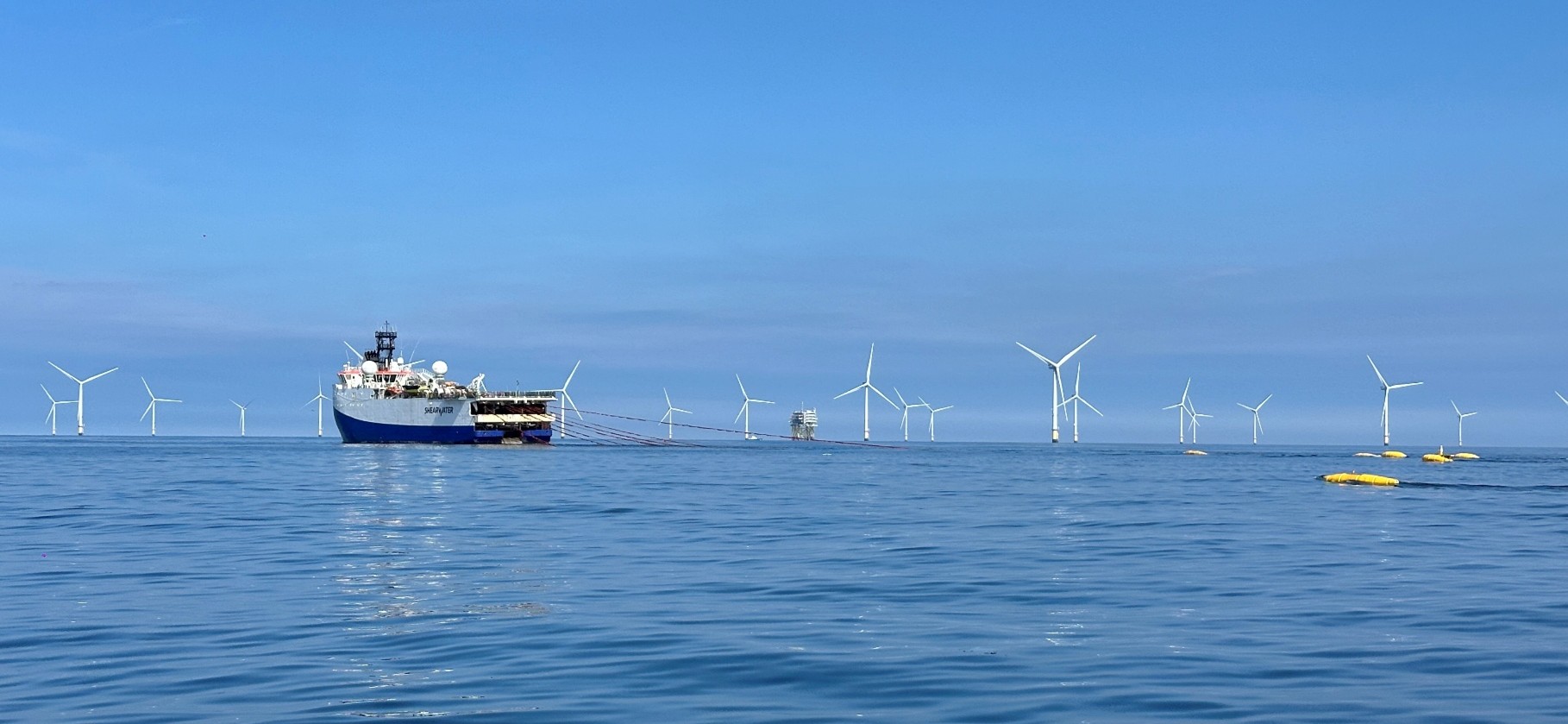
Spirit Energy is a pioneering company looking to pursue energy transition opportunities from its existing assets. Spirit Energy were awarded the CS010 carbon storage licence in 2023 which includes the North Morecambe and South Morecambe depleted gas fields.
Spirit Energy has been the sole operator of these fields for over 40 years and is actively progressing the Morecambe Net Zero project to re-purpose them into nationally significant carbon storage sites.

THE
CHALLENGE
Each carbon storage site presents unique geological challenges, requiring tailored, site-specific imaging for both pre-injection characterisation and subsequent CO₂ monitoring. These sites demand modern, high-resolution data to de-risk the overburden and accurately characterise the reservoir.
Spirit Energy’s Morecambe Net Zero (MNZ) project has ambitions to store up to 1 gigaton of CO2 using the depleted Morecambe Bay gas fields. With an extremely complex over-burden combining shallow water depths, glacial deposits and sub-cropping near surface salt, re-processing legacy data had reached the limit of fit-for-purpose.
The Morecambe Bay gas fields presented a complex technical challenge, so we needed a modern solution to enable detailed subsurface characterisation of our carbon storage sites, says Helen Basford, Senior Geophysicist at Spirit Energy.
At Shearwater, we were tasked to create an integrated approach to the geophysical problem through acquisition and processing of a 3D seismic dataset over the survey area. Whilst a producing gas field, the number of platform wells in the survey area is relatively limited meaning a single vessel acquiring towed-streamer seismic data was suitable.
THE
SOLUTION
The seismic acquisition was designed to focus on the challenge of maximising resolution without compromising operational efficiency. Extensive survey modelling was carried out to ensure the input data met expectations for a High-Resolution seismic survey. This involved detailed planning to image the area around five platforms, minimizing coverage gaps by using close passes enabled by our proprietary technology and multiple orthogonal lines.
In addition to complex geology and field infrastructure, the survey area was crowded with ferry, fishing and field traffic. Coordination with third party vessels was key to project success to maximise data coverage within client budget, particularly important for CCS.
Shearwater’s seismic vessel, SW Amundsen, used a towing configuration designed to achieve efficient seismic acquisition without compromising sampling, enabled by our Isometrix streamer technology. The wide tow on the sources similarly gave good near offset coverage to the outer cables, giving the subsequent processing a step up on de-multiple and regularisation. Both of which are key processes for any shallow water survey, and especially so in the CCS context of derisking the shallow subsurface.
We took a truly integrated approach where acquisition and processing teams worked together from the start to design the seismic survey, ensuring the parameters set us up for successful processing and delivery.
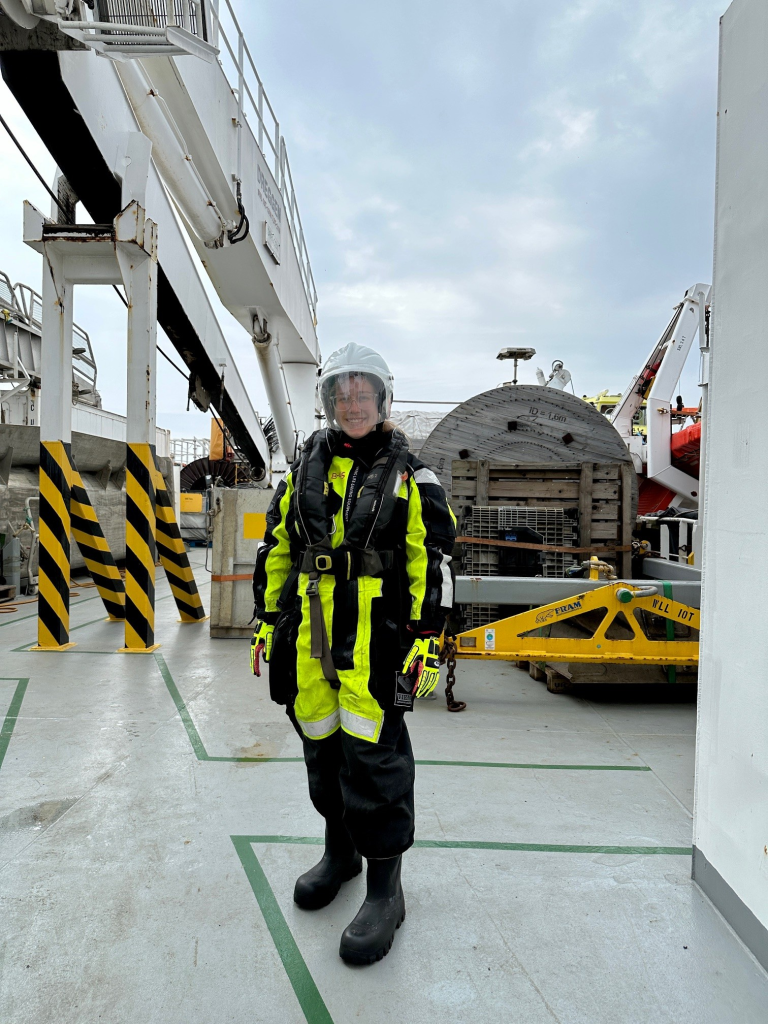
Image: Catherine Geary, Project Geophysicist at Shearwater on the seismic vessel SW Amundsen.
Advanced survey design and operational planning was further augmented with offshore processing, providing close collaboration with onshore processing teams enabling a smooth and efficient start to the processing. Ultimately ensuring acquisition parameters matched efficiency constraints without compromising data quality.
This collaboration was clearly demonstrated by Project Geophysicist Catherine Geary, who joined the offshore team specifically for this project. She worked on the data as it was acquired and then brought it back onshore, where she resumed her usual role in the processing team to help deliver a seamless, integrated solution.
KEY POINTS
OF THE
SOLUTION
- Isometrix multi-component streamer – high quality receiver de-ghost, often a challenge in wide-tow, shallow water environments.
- Source volumes – using knowledge from neighbouring surveys in the Irish Sea, source volume was kept high enough to provide good low frequency content, important for FWI and expected steep dips in the near surface whilst still providing a high peak frequency for near surface resolution.
- Near Inline offset allowing for quality regularisation and facilitating de-multiple.
- Wide source tow to minimise near offset on the outer cables.
The existing legacy data was poor in detail, particularly in the near surface, and was prone to noise and multiple through the section. The objective of the new data was to give a high quality, high-definition image throughout the section. Equally important, the result had to be a quality depth migrated image that tied closely to the wells. Such a product was key for enabling confident assessment for Spirit Energy in evaluating their CCS prospect.
To do this an experienced processing and imaging team from Shearwater, with extensive knowledge of processing seismic data for CCS, was assigned. Leveraging both the flexibility of our proprietary software, Reveal, and lessons learned from other CCS projects, a bespoke processing flow was derived that met the challenges of the data. We used a flexible, collaborative approach to combine Spirit Energy’s geological insights with Shearwater’s geophysical expertise in processing. This meant that key processing stages such as de-multiple, de-noise and 4D regularisation, benefited from a joined-up, iterative approach to peel back the layers of noise and multiple to ensure the final data was meeting key objectives in a timely manner.
"To enable Spirit Energy with confident assessment of their CCS prospect, we collaborated closely with their geological team, says Catherine Geary, Project Geophysicist at Shearwater."
Catherine Geary, Project Geophysicist
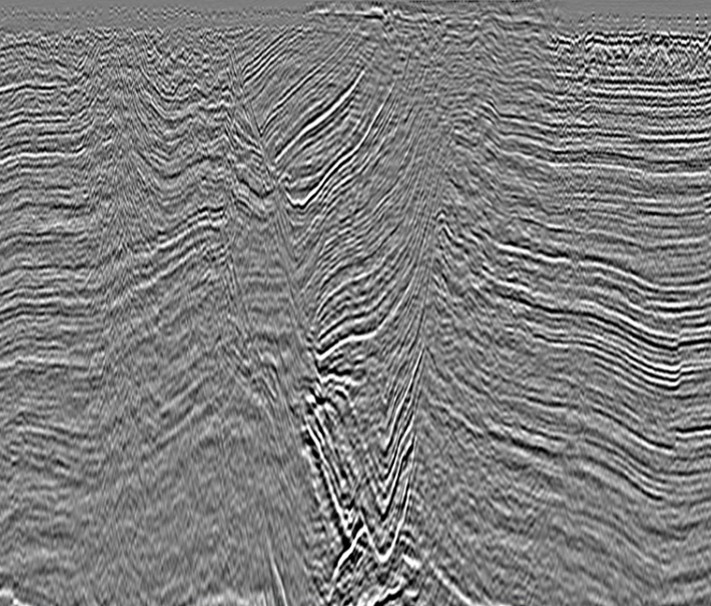
Image: Legacy data over Morecambe Bay.
No less important than the pre-processing was the velocity model building and depth imaging. Again, geological input from Spirit Energy was key in ensuring the velocity model tied to the geological understanding of the region given the geological complexity of the dataset. A particular challenge in this area was the complexity in the near surface where Quaternary glacial channels filled with slow velocity are proximal to interbedded salt and clastics giving significant lateral and vertical velocity contrasts in the near surface.
Mixed in with grabens with large fault displacement, there were significant challenges to velocity model building that all needed to be accurately represented in the final velocity model to ensure a quality depth migrated image.
This was achieved through a close integration of the well data and geological input from Spirit Energy. Iterative PreSDM volumes supplied were key in getting quick decisions so the velocity model could be iteratively updated. Full Waveform Inversion (FWI) was utilised to get the near surface velocities sufficiently represented in the model to allow a good depth migration of deeper targets. This approach would not have worked without collaboration from all parties to tackle the imaging challenge together.
The collaborative partnership with Shearwater has resulted in a step-change in the subsurface image quality we needed to fully characterise our Morecambe Bay carbon storage sites, says Phil Ware, Senior Geoscientist at Spirit Energy.
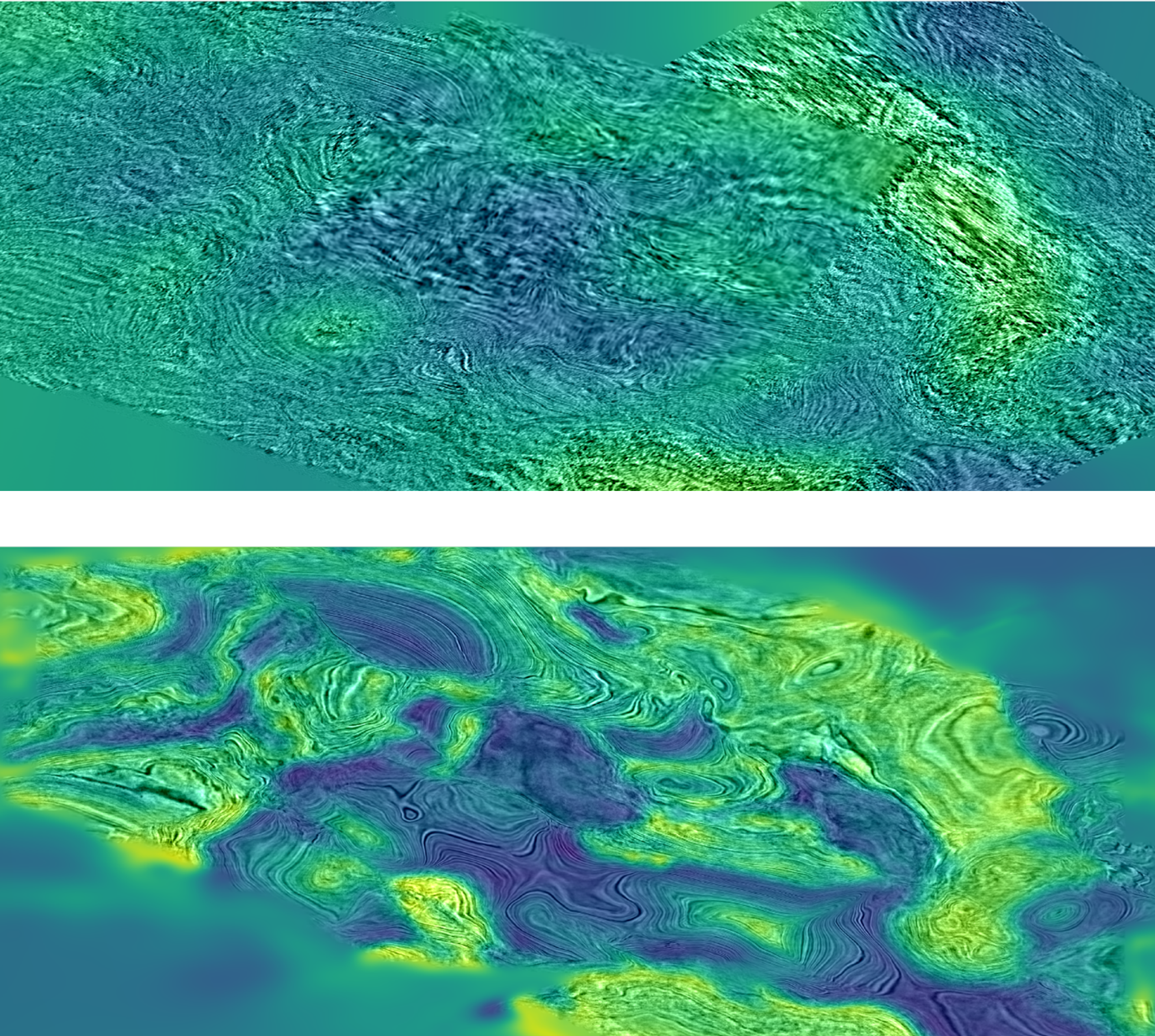
Image: Comparison of near surface depth slice between the legacy data and final PreSDM stacks with respective velocity models overlain.
THE
RESULT
Shearwater were presented with the challenge to provide tailored, site-specific imaging of an extremely complex overburden combining glacial troughs with near surface salt. The Morecambe Fields are emblematic of several CCS sites globally demanding modern, high-resolution data to de-risk the overburden and accurately characterise the reservoir.
Close collaboration with Spirit Energy enabled delivery of a high-quality, custom seismic dataset. This marked a major improvement over legacy data, offering a detailed and consistent view of the subsurface for the Morecambe Net Zero project. The improvements extended beyond vertical resolution. Enhanced imaging fidelity and character provided greater confidence in data integrity, particularly in the shallow section. This improved shallow imaging is critical for understanding the overburden and plays a key role in de-risking potential CO₂ leakage pathways.
Shearwater met this site-specific challenge using modern acquisition and processing methods that reflects our integrated approach, leveraging our continuous innovation in both technology and software. A high-resolution dataset to de-risk a crucial part of the UK’s CCS infrastructure was achieved within budget and within time. The latter was remarkable given the original timeline was set 3 years ago, and yet Shearwater and Spirit Energy were able to present results to the North Sea Transition Authority within just 2 weeks of that original projection.
1
Quality dataset fit for the purpose of CCS site evaluation
100Hz+
Resolution above storage site
100%
“Perfect Days” Client Safety initiative with donation to crew’s chosen charity.
"THE SEISMIC PROJECT HAS GREATLY ENHANCED OUR UNDERSTANDING OF THE AREA'S GEOLOGICAL SETTING ALLOWING US TO CONFIRM ITS SIGNIFICANT POTENTIAL FOR CARBON STORAGE."

Chris Ward
Subsurface CCS Lead at Spirit Energy
Acknowledgement
Thanks go to the Shearwater project teams and support groups for delivering the processing.
Thanks also go to Spirit Energy for permission to share this work.
WATCH THIS
SPACE
As Shearwater’s portfolio on CCS projects expands, so does our experience base. All our learnings across acquisition and processing are combined and our technical experts continue to enhance our integrated solutions through continuous improvement and partner collaboration – solving CCS challenges and contributing to the energy transition.
Recent developments include:
- Shearwater can now provide zero-offset trials on both zero offset solutions through our proprietary Qmarine and Isometrix technology. Investment in sea trails on 2 separate vessels to ensure the solution could be provided efficiently and safely allowed us to update our mobilisation procedures and provide confidence to our future clients looking for a step-up in resolution.
- An upgrade to our Isometrix technology through 1ms sampling offers a Single Sensor, Multi Component and now Zero-offset High-Resolution solution well suited to meet CCS challenges. Tests showcasing the possibility of 1ms sampled multi-component solutions.
- Roll-out of Elementi FWI, our new Spectral Elements Method (SEM) FWI, pushing the limits of sub-surface imaging.
News
Press Release
08/09/2026
Shearwater awarded North Sea OBN survey featuring first deployment of electric ROV technology

GET IN TOUCH
Dave Forecast, our storage solutions expert is here to help.