
Insight article
The next era of Reveal is agentic
21 Oct 2026
When Reveal ML (Machine Learning) was introduced in August, we hinted that more will come in future releases. We are now launching the Reveal Agent project: developing an AI assistant that works with and inside Reveal alongside the processor. We are thrilled we will be collaborating with NVIDIA in developing it.
“Agentic” and what it means in Reveal
Most AI chat tools answer questions. An agent takes action. In our research so far, the agent can plan a piece of work, build a processing flow, run it, check the results, explain its choices, and stop to ask when something isn’t clear.
Reveal itself doesn’t change. What changes is how you work with it. Instead of clicking and dragging tools into place, you describe what you’re after and review what comes back, or instead of taking days to learn new tech, you’ll have a helping hand to make you the expert.
Teaching AI to speak seismic
General-purpose AI assistants have become very good at writing software, but they know nothing about Reveal or the conventions of seismic processing. We discovered that building a processing flow looks a lot like writing a program: you read in data, apply a sequence of steps, and write out the result.
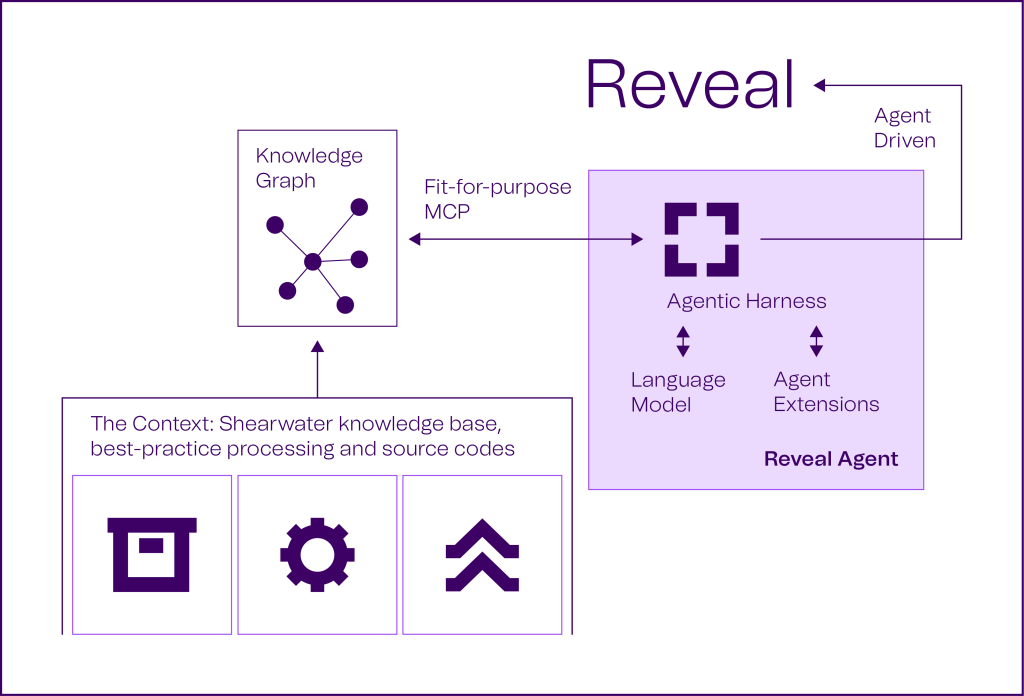
For the first prototype, we started from an established AI coding assistant and gave it what it was missing. Along this road, we learned a lot about curating and appropriately setting context that is fit-for-purpose to our needs and those of our customers. That includes an agent-ready structured map of Reveal’s roughly 450 tools and how they fit together, our own processing know-how, and real example flows to learn from. The product will be ours from end to end. We will curate the knowledge the agent draws on, build the framework that connects it to Reveal, design the tests that measure its performance and maintain its security, and decide how and which AI models are used. That knowledge and engineering will be developed and owned by Shearwater, just like the rest of Reveal.
Early results
In one of our first experiments, we gave the agent a short request to build a flow for adaptive subtraction, a common step for removing unwanted energy from seismic data. It researched the method and looked at neighbouring projects within its sandbox, to pick up the team’s naming conventions. It asked one clarifying question, presented a plan for approval, and then built a flow that matched our own best practice. When we asked why it had chosen a particular setting, it explained its reasoning and backed it up with numbers pulled straight from the data.
The agent can also use Reveal ML on the processor’s behalf. We asked the agent to replace an effective but computationally expensive clean-up step on ocean-bottom node data with a machine learning model. It set up the whole thing: preparing training data, trying out different network designs, training the model, and measuring the results against the conventional approach. The trained model closely reproduced the conventional result at a fraction of the cost. For processors who are new to machine learning, this could turn a steep learning curve into a conversation.
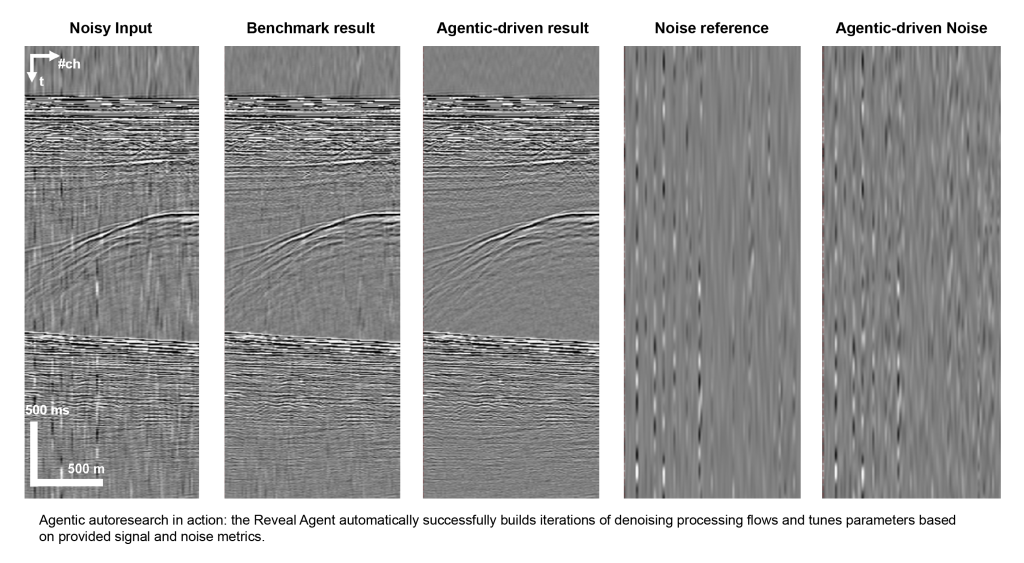
We also let the agent refine an existing flow by itself – opening the door to automated QC in complex tasks. Given a flow for removing swell noise and a score to improve, it tried a series of adjustments over ten rounds, kept the ones that helped, and discarded the rest. On the first attempt, it cleaned the data too aggressively and removed real signal, because the score we gave it allowed that. With a better score, the final result removed more noise than the starting flow without losing signal. Along the way, its reasoning looked a lot like an experienced processor’s. The lesson is an important one: an agent is only as good as the goal you give it.
People in charge by design
That lesson is why human oversight will be built into the Reveal Agent from day one. Users approve plans before any work is done. Every session is recorded, so each step behind a result can be reviewed later, even months afterwards. Our own growing set of test questions and tasks lets us measure the agent consistently and compare different AI models on equal terms as the technology evolves. It’s the same principle behind the experiment tracking in Reveal ML: results you can trust, check, and reproduce.
These experiments are only the starting point. Over the coming months, we’ll be turning them into a final product, working closely with NVIDIA as we deepen our collaboration that already spans high-performance computing and machine learning.
We’ll report more soon on the agent, its capabilities, the product, and NVIDIA’s role in helping bring it to life.
It’s AI built the way we build everything at Shearwater: useful and robust first, and accountable over what it does.
Related articles
Reveal
Reveal delivers faster, more energy-efficient seismic workloads on the Arm-based NVIDIA Grace Hopper platform

Reveal
Reveal 7.0 brings new data control, workflow updates and machine learning tools
